
Electrosurgical instruments play a central role in modern operating rooms, enabling surgeons to cut, coagulate, and control bleeding with precision and efficiency. As hospitals upgrade operating theaters and distributors expand their surgical portfolios, understanding the differences between bipolar and monopolar electrosurgical instruments has become critical for informed procurement decisions.
While both technologies rely on high-frequency electrical energy, their design, applications, safety profiles, and purchasing considerations differ significantly. Choosing the right instruments impacts not only surgical performance, but also operating room safety, equipment compatibility, and long-term cost efficiency.
This guide provides a clear, practical comparison of bipolar vs monopolar electrosurgical instruments, tailored for:
Hospital procurement teams
Surgical departments
Medical device distributors and importers
OEM and private-label buyers
Drawing on manufacturing and market experience from Electro Bismed, this article explains how each technology works, where each is best used, and how buyers can select reliable, compliant instruments for their specific clinical and commercial needs.
What Is the Difference Between Monopolar and Bipolar Electrosurgery?
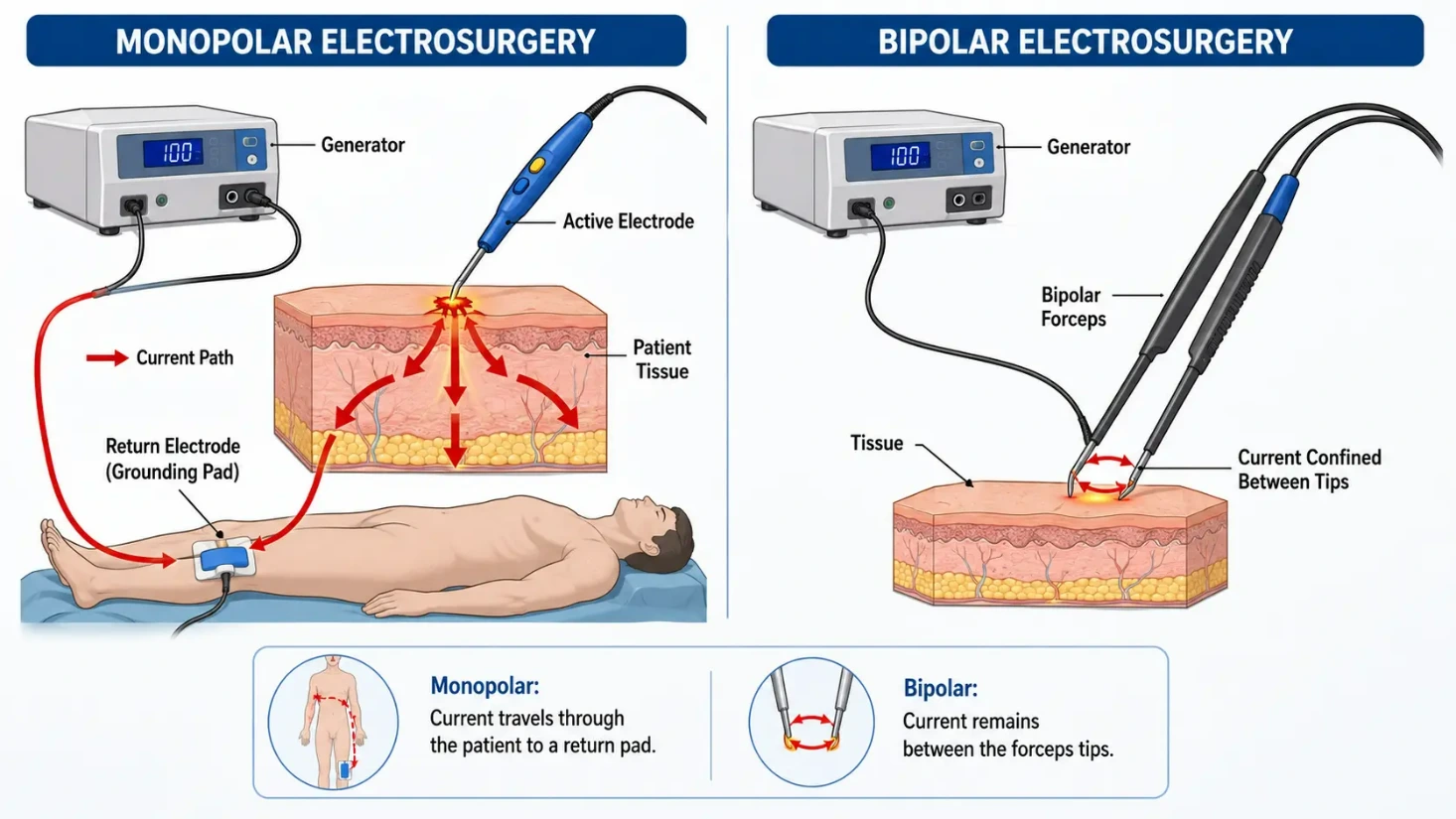
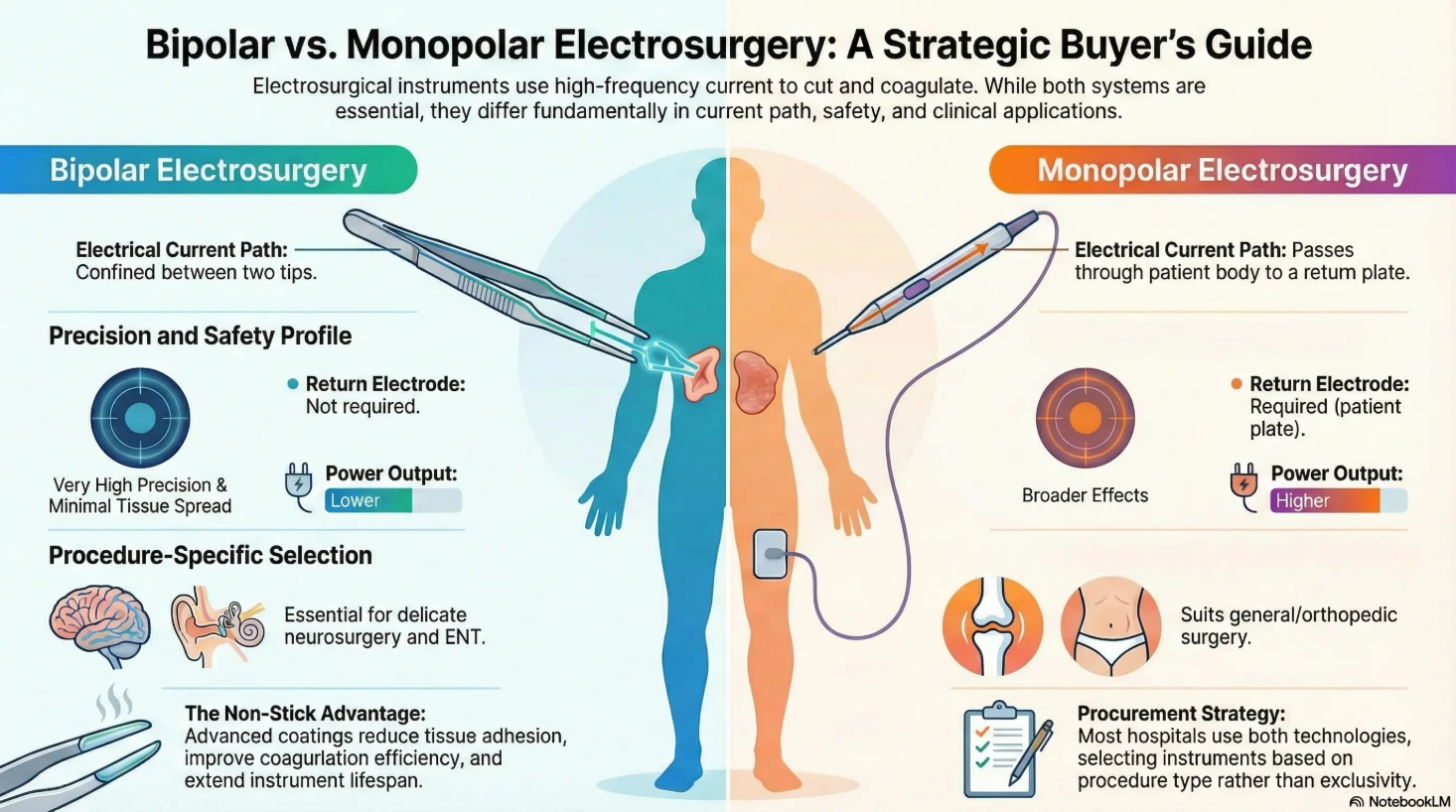
The main difference is how electrical current returns to the generator. In monopolar electrosurgery, current passes through the patient's body to a return electrode (grounding pad), enabling higher power and broad tissue effects. In bipolar electrosurgery, current stays confined between the two tips of a forceps, giving greater precision and safety for delicate procedures.
Bipolar vs Monopolar: Side-by-Side Comparison
| Feature | Bipolar Instruments | Monopolar Instruments |
| Current path | Confined between two tips | Passes through patient body |
| Return electrode | Not required | Required (patient plate) |
| Precision | Very high | Moderate to high |
| Tissue spread | Minimal | Broader |
| Safety profile | Higher in delicate surgery | Requires strict grounding protocols |
| Power output | Lower | Higher |
| Common use | Fine coagulation | Cutting and large-area coagulation |
Understanding Electrosurgical Technology
Electrosurgery uses high-frequency alternating electrical current to generate heat within tissue. This heat enables controlled cutting, coagulation, desiccation, or tissue sealing depending on the instrument and settings used.
The fundamental difference between bipolar and monopolar systems lies in how electrical current travels through the patient and returns to the generator.
Monopolar Electrosurgical Instruments: How They Work
In monopolar electrosurgery, electrical current flows:
From the electrosurgical generator
Through the active electrode (e.g., pencil or forceps)
Into the patient’s tissue
Out through a return electrode (patient plate)
Back to the generator
Because the current passes through a larger portion of the patient’s body, monopolar instruments are capable of higher power output and broader tissue effects.
Common Monopolar Instruments
Electrosurgical hand control pencils
Monopolar forceps
Needle, blade, and ball electrodes
Monopolar cables and accessories
Typical Clinical Applications
General surgery
Abdominal and gastrointestinal procedures
Orthopedic surgery
Dermatology and plastic surgery
Procedures requiring rapid cutting over larger areas
Bipolar Electrosurgical Instruments: How They Work
In bipolar electrosurgery, both the active and return electrodes are integrated into the same instrument—most commonly a pair of forceps. Electrical current flows only between the two tips of the instrument and passes exclusively through the targeted tissue.
This confined current path allows for greater precision and improved safety, particularly in delicate surgical environments.
Common Bipolar Instruments
Bipolar forceps (straight, bayonet, angled)
Non-stick bipolar forceps
Bipolar cables compatible with generators
Typical Clinical Applications
Neurosurgery
ENT procedures
Ophthalmic surgery
Microsurgery
Pediatric and delicate soft-tissue procedures
Clinical & Operational Advantages
Advantages of Bipolar Electrosurgical Instruments
Enhanced precision in delicate surgical fields
Reduced risk of unintended thermal injury
No patient return electrode required
Ideal for surgeries near nerves or sensitive structures
Improved control during coagulation
Advantages of Monopolar Electrosurgical Instruments
Faster tissue cutting
Higher power capability
Versatility across a wide range of procedures
Lower instrument cost per unit
Widely compatible with most generators
In practice, most hospitals use both technologies, selecting instruments based on procedure type rather than choosing one exclusively.
Safety Considerations for Procurement Teams
Safety is a shared responsibility between manufacturers, hospitals, and distributors. Each technology presents distinct considerations:
Monopolar Safety Factors
Proper placement of the patient return electrode
Generator compatibility and grounding checks
Insulation integrity of cables and electrodes
Staff training on correct usage
Bipolar Safety Factors
Insulation quality at forceps tips
Tip alignment and closing pressure
Generator output compatibility
Cable integrity and connection reliability
From a purchasing standpoint, safety begins with manufacturing quality, validated materials, and documented inspection processes—not just clinical technique.
Quality & Compliance: What Buyers Should Look For
Electrosurgical instruments are regulated medical devices. Whether purchasing for hospital use or resale, buyers should confirm that manufacturers meet recognized quality standards.
Key Compliance Indicators
ISO 13485 certification for medical device manufacturing
Controlled production processes
Traceability through batch or lot identification
Material certification for stainless steel and insulation
Documented quality inspection protocols
At Electro Bismed, electrosurgical instruments are manufactured under ISO 13485-aligned systems with structured in-process and final inspections to ensure consistent performance across batches.
Non-Stick Coatings & Advanced Features
One of the most common upgrades in both bipolar and monopolar instruments is the use of non-stick coatings.
Benefits of Non-Stick Electrosurgical Instruments
Reduced tissue adhesion
Cleaner tips during surgery
Improved coagulation efficiency
Easier post-procedure cleaning
Extended instrument lifespan
For distributors, non-stick bipolar forceps and coated monopolar tips often command higher margins and stronger surgeon preference, particularly in repeat purchasing environments.
Generator Compatibility: A Practical Buying Factor
Electrosurgical instruments must be compatible with the generators used in the operating room. While many bipolar and monopolar instruments are designed to work across multiple systems, variations in connectors and power settings exist.
Procurement teams should confirm:
Connector type (2-pin, 3-pin, proprietary)
Recommended power ranges
Compatibility with existing generators
Availability of matching cables and accessories
Manufacturers experienced in export markets typically provide clear compatibility guidance to prevent post-purchase issues.
OEM & Private Label Considerations for Distributors
For distributors and importers, bipolar and monopolar electrosurgical instruments represent strong opportunities for OEM and private-label branding.
Common Private-Label Options
Laser marking of brand name or logo
Custom reference numbers
Branded packaging and labeling
Product documentation under buyer’s brand
Starting with standard, proven designs allows distributors to enter the market with lower risk, while still building brand recognition. Over time, specifications can be refined based on surgeon feedback and market demand.
Electro Bismed supports private-label projects with controlled specifications, repeatable production, and export-ready documentation.
Cost Considerations & Long-Term Value
While monopolar instruments often have lower upfront costs, bipolar instruments may offer greater long-term value in specific surgical environments due to reduced complication risk and longer service life.
Buyers should evaluate:
Unit cost vs procedure type
Replacement frequency
Surgeon preference
Maintenance and cleaning requirements
Brand reliability across repeat orders
A balanced inventory strategy—stocking both bipolar and monopolar instruments—is typically the most cost-effective approach for hospitals and distributors alike.
Typical Product Range in Electrosurgery
A comprehensive electrosurgical portfolio may include:
Bipolar forceps (various lengths and tip styles)
Electrosurgical hand control pencils
Electrodes and accessories
Cables compatible with major generators
Offering a complete range simplifies procurement for hospitals and increases average order value for distributors.
Frequently Asked Questions (FAQs)
1. Can bipolar instruments replace monopolar instruments entirely?
No. Bipolar instruments excel in precision coagulation, but monopolar instruments remain essential for cutting and large-area tissue work. Most operating rooms require both.
2. Are bipolar instruments safer than monopolar?
Bipolar instruments generally offer a higher safety margin in delicate procedures due to limited current flow. However, both are safe when used correctly with compliant equipment.
3. Do non-stick coatings wear out?
High-quality coatings applied under controlled processes are designed to withstand repeated sterilization cycles. Poor-quality coatings may degrade faster.
4. Can distributors private-label electrosurgical instruments?
Yes. Many manufacturers, including Electro Bismed, support OEM and private-label programs with branding, packaging, and documentation options.
5. What is the difference between monopolar and bipolar cautery?
The terms mirror electrosurgery: monopolar cautery sends current through the body to a return pad and suits cutting and large-area coagulation, while bipolar cautery confines current between two tips for precise, low-risk coagulation. "Cautery" and "electrosurgery" are often used interchangeably in practice, though technically true cautery uses heat alone.
6. Which is better for TURP — monopolar or bipolar?
Bipolar TURP (transurethral resection of the prostate) is increasingly preferred because it allows the use of saline irrigation, reducing the risk of TUR syndrome, and generally offers improved intraoperative safety. Monopolar TURP remains widely used and effective. The choice depends on generator compatibility, surgeon preference, and case specifics.
7. Is bipolar electrosurgery more expensive than monopolar?
Bipolar instruments often carry higher upfront and maintenance costs, but they can deliver greater long-term value in delicate procedures through reduced complication risk and longer service life. Monopolar instruments typically have lower cost per unit. Most facilities stock both and select by procedure type.
8. Can monopolar and bipolar instruments be used on the same generator?
Many modern electrosurgical generators support both monopolar and bipolar modes, but connector types (2-pin, 3-pin, proprietary) and power settings vary. Always confirm connector compatibility and recommended power ranges before purchasing instruments or cables for an existing generator.
Making the Right Choice
Choosing between bipolar and monopolar electrosurgical instruments is not about selecting a “better” technology—it’s about selecting the right tool for the right procedure, backed by reliable manufacturing and consistent quality.
For hospitals, this ensures surgical safety and performance.
For distributors, it ensures long-term customer trust and repeat business.
Electrosurgical Manufacturing with Electro Bismed
Electro Bismed manufactures bipolar and monopolar electrosurgical instruments under controlled processes designed for international markets. We work with hospitals, distributors, and OEM partners seeking consistent quality, compliant documentation, and scalable production.
We support partners with:
ISO 13485-aligned manufacturing
Bipolar and monopolar instrument ranges
Non-stick coated options
Private-label branding solutions
Export-ready packaging and documentation
Ready to Discuss Your Requirements?
Whether you are evaluating electrosurgical instruments for hospital procurement or planning to build a private-label product line, our team can guide you through specifications, compliance, MOQ, and lead times.
Contact Electro Bismed to explore reliable electrosurgical solutions designed for performance, safety, and long-term market success.